
Welcome to the latest edition of Unpacking Commerce, our newsletter about emerging trends in retail, brands, and new commerce.
👉 TL;DR - three takeaways from this edition:
Mid-market fashion: French clothing demand is splitting in two - ultra-fast and resale now take one garment in four, while premium holds its ground and the brands stuck in the middle go under. Shoppers pick a side, cheap or credible premium; neither chooses the middle.
Discount: the shift to discount stores is permanent, not just a recession reflex. Once households move their everyday spending to a chain like Action, they don’t switch back when budgets recover - which is why Action keeps growing (€16bn in sales) in good times and bad.
Marketplaces: surviving Amazon takes more than a product catalogue - you need services Amazon can’t easily copy, like payments, delivery and ads. Rakuten France never built them and is shutting down; Greece's Skroutz did, and just agreed to sell for €635m.
👕 Mid-market fashion’s missing customer
French clothing demand is splitting in two - hard value at one end, genuine premium at the other - and the middle is the casualty. Ultra-fast and resale now take one garment in four sold in France, while a dozen mid-market chains entered administration in 2025-26. Premiumisation is the sector's instinctive escape, but shoppers trade up only to brands with real credibility, never to a mid-market name that has simply raised its prices. They pick a side, and the middle is chosen by neither.
📉 The French apparel market closed 2025 down 1.6% in value and, at roughly €35bn, still sits below its pre-pandemic 2019 level - six years on, and the market has never climbed back, a gap no warm December explains. The mid-segment, in the IFM's own words, is particulièrement exposé. The data underneath is harder than the euphemism.
🧵 The IFM's price rankings show why. Shein, Temu and AliExpress took 6% of unit volume, Temu leaping from 24th to 15th over 2025. Secondhand reached 11.2% of apparel spend overall, and 18% among 18-24s. Ultra-fast and resale together now claim one item in four sold in France and 13% of value. The volume top-ten opens with Vinted, Kiabi, Amazon, Decathlon and Shein. Not a mid-market brand in sight.
🪞 Far from competing, the two extremes operate as coordinated educators of the same consumer. Once a t-shirt sells for €5 secondhand on Vinted, or €4 new on Shein, the same item at €40 in a mid-market shop becomes impossible to justify. Secondhand is making new-product prices harder for French shoppers to accept, while 56% of women aged 16-24 already buy ultra-fast fashion. What reads as a recession-era detour is the end of a thirty-year price architecture.
🏗️ The casualty roll keeps growing through 2025 and 2026: IKKS, Jennyfer, Kaporal, Princesse Tam Tam, Comptoir des Cotonniers, Anne Fontaine, NafNaf, Pimkie, Jott, Okaïdi, Balibaris, Bensimon… The first names fell back in 2020, blamed on the pandemic. But the rebound never came: each year since has brought a fresh alibi - supply chains, inflation, the weather - while the same structural drain ran underneath. Spending came back; the mid-market did not, because the money had already rerouted to the two ends. Category architecture rewriting itself.
🌀 There are two ways out, up or down - and for a mid-market brand the numbers shut both. Up means going premium, which takes real credibility, not just a higher price tag. Inditex (Zara) has it: group sales reached €39.9bn (+3.2%) and a record net profit of €6.22bn, built on two decades of vertical supply chain and earned pricing power. Most mid-market names have neither. Down means undercutting Shein on its own turf - Chinese factories, AI demand prediction, no stores, no rent - which no legacy retailer can achieve. So the best-resourced incumbents don't try to go lower; they defend margin by shrinking instead. H&M is the clearest case: Q1 2026 sales fell 1%, yet operating profit rose 26%, thanks to 163 net store closures. That is survival by subtraction, not a route back to growth - and it is all the squeezed middle has left.
Apparel is patient zero: lowest friction, so it cracked first - low switching cost, high frequency, low utility per item, fast disposal, each stripping a reason to pay up for the middle. The lower the friction, the sooner the middle falls. Beauty, sportswear and home are in line; which cracks first is the only open question.
🛒 The irreversible discount
Action closed 2025 at €16bn in net sales. The "discount thrives in inflation" framing treats as cyclical what hard food discount already proved durable: format superiority compounds, and a modest recovery in purchasing power doesn't reverse a consumer rewired across a decade.
🏷️ The 2025 numbers force a structural rather than cyclical reading. €16 billion net sales (+16.1%), 21.6 million weekly customers (+15.5%), 384 stores added, 3,302 in 14 countries; operating EBITDA €2.4 billion at ~15% margin - a level no general retailer can credibly match. France passed 900 stores in December 2025 and remains the largest market.
🔧 The mechanic is format economics, not inflation pressure on basket. ~6,000 SKUs against 20,000+ in a traditional supermarket. A deliberate mix of A-brands, Action private label and supplier white-label - not the all-own-brand model of food hard discount. Peri-urban locations with ultra-low rent. Regional warehouses feeding the stores. Supplier terms tightened to non-comparable levels by thirty years of consistent volume signal. This is what Aldi and Lidl proved on food over two decades, and what B&M, Pepco and Action are now proving on non-food. Once a household has shifted its baseline spending to Action's treasure-hunt format, a marginal recovery in purchasing power doesn't pull it back. The lower price point resets the reference, the same way it does in apparel.
🌍 The expansion curve is the tell. Action had close to 100 stores in 2002, 300 by 2012 (the year it entered France), more than 1,800 by 2021, then 2,500 in late 2023, 3,000 by mid-2025 and 3,302 by year-end 2025. If this were a cyclical bump, the cadence would be flattening; it's steepening. Slovenia opens in 2026, and a US launch is in preparation, with 100 stores planned there by 2030.
Action already stocks beauty, home, garden and small electronics as side aisles. Scale them, and the specialists in each will learn what killed apparel's mid-market: a customer who was never loyal, only ever short of a cheaper option.
⚔️ Marketplaces: who survives Amazon?
In the same week of May, Rakuten France launched a sale-or-shutdown process for its marketplace, and Blackstone agreed to buy Skroutz from CVC at €635m. The two events look opposite but trace one pattern: a generalist catalogue dies in Amazon's path, while a marketplace that owns the fintech-logistics-ads stack survives - even where Amazon competes.
📉 Rakuten France, ex-PriceMinister, acquired in 2010 for €200m, lost 33% of its active buyers and 42% of its traffic over a decade. Q3 2025 monthly unique visitors: 9.5m against Amazon at 38.8m. Closure begins in Q3 2026 if no buyer materialises - and any credible suitor would be an incumbent shopping for capability it lacks, not a healthy marketplace.
📈 Skroutz is changing hands from CVC to Blackstone at €635m, doubling CVC’s investment. The description matters more than the multiple: marketplace plus proprietary last-mile, fulfilment, licensed fintech and retail media, serving 2.5m users across Greece, Cyprus, Romania and Bulgaria. The take rate compounds across four layers.
🗺️ The pattern repeats across Central and Eastern Europe. Allegro now runs its own ads business, lending arm and parcel network, with Allegro Pay financing around 15% of Polish GMV. eMAG has pushed its fintech to 13% of Romanian GMV, up from 7% a year earlier, on top of marketplace, logistics and loyalty layers. Both monetise through layers that Amazon does not run locally.
One variable decides which marketplaces survive Amazon: whether they own a layer it can't cheaply replicate. Amazon has been selling in Poland since 2021, yet Allegro still dominates - its ads, lending and logistics stack lock in merchants and buyers in ways a catalogue cannot. Skroutz and eMAG built the same moat in markets Amazon barely contests. Without it, a marketplace is just a generalist catalogue in Amazon's path - Rakuten France, Cdiscount - with nothing to defend. The €635m Blackstone paid for Skroutz is what that moat costs once it exists.

🚀 Ouidrop raised €7m to scale its autonomous drive. Its "Dropper" is a tri-temperature grocery pickup robot - ambient, fresh and frozen, running 24/7 on 30-50m² - already live with E.Leclerc, Intermarché and U. The round was led by Épopée Gestion and Swen Capital Partners, with Spring renewing the backing it first committed in 2023.
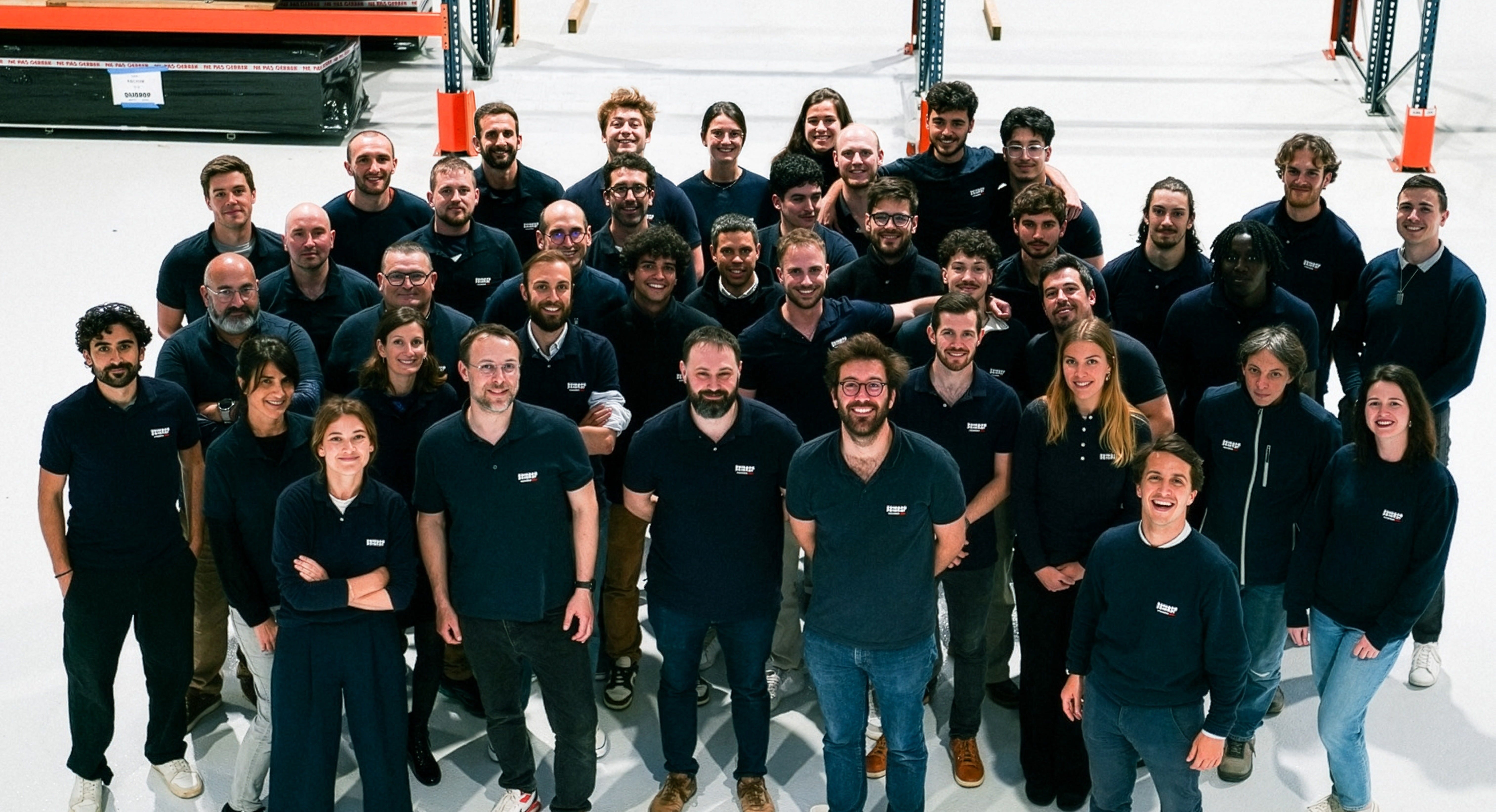
🎙️ Most deals get told from one side. This Just Focus episode puts both in the room - Laurent Foiry (Spring Invest) and Martin Bour (founder of Acolyt, a premium 3PL for fashion and beauty) - five years in, making the case that you raise from a fund for what you learn as much as for the money.

Bain, Synthetic Customers Earn Their Stripes. AI “digital twins” of your customers now reproduce roughly 90% of traditional survey results. Worth reading for the catch Bain underplays: a model validated by how well it matches past studies is structurally blind to the one thing research exists for - telling you what you don’t already know.
Eric Seufert (Mobile Dev Memo), Google’s Gambit, Part 4: The End of Static Search. The clearest read on what AI search does to retailers’ economics: as Google’s results turn conversational, it packs more ads into each session and shrinks the gap between browsing and buying - so reaching the same customer costs more. If your acquisition costs are about to climb, this is why.
Ana Andjelic (The Sociology of Business), Paying the price. The top-end version of this edition’s deep dive: luxury raised prices across every tier until even the wealthy “started doing the math” - and once a buyer is calculating, the irrational prestige they were paying for is already gone. Premiumisation hits a wall at the top, exactly as it does in the middle.
👍 If you like Unpacking Commerce and want to help it grow, please share this newsletter with your colleagues, followers, and friends. Have a great day!
About us
Spring Invest is a European investment fund dedicated to companies that are shaping the future of commerce. We champion doers who build innovative companies making commerce better, from enabling technologies to new commerce models and everything in between. More info about our investment thesis 👉 here.