
Welcome to the latest edition of Unpacking Commerce, our newsletter about emerging trends in retail, brands, and new commerce.
💥EXIT💥
One piece of news from Spring before we start.
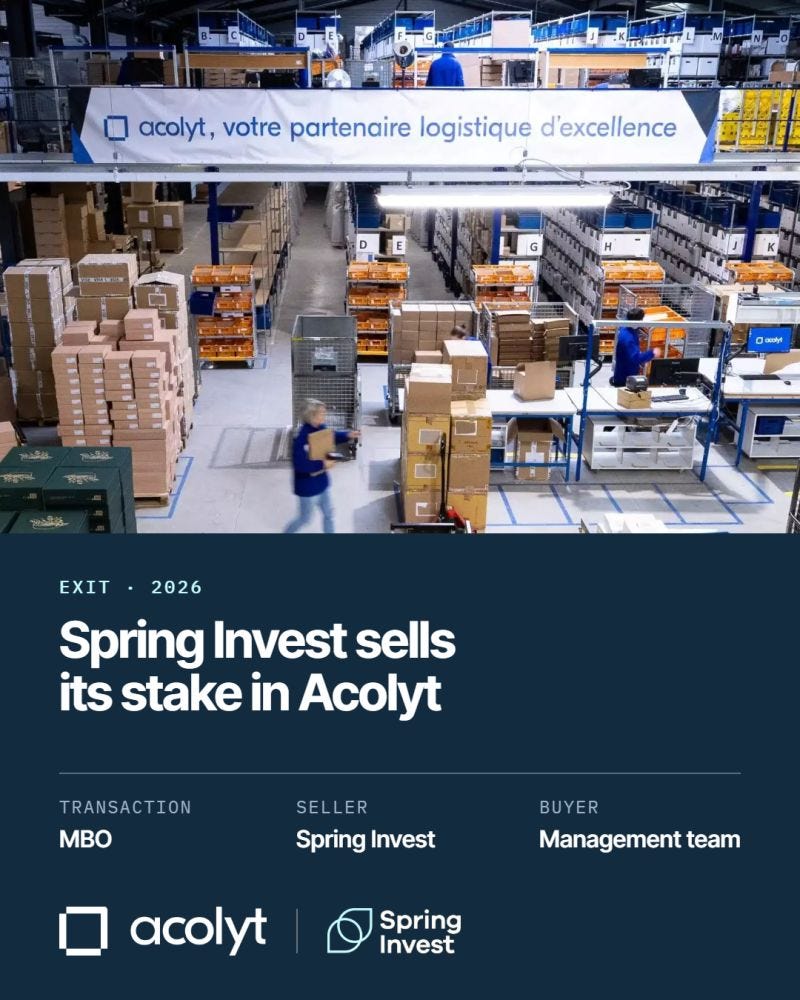
We are very happy to announce that Spring Invest has sold its stake in Acolyt, which runs e-commerce and retail logistics for premium brands, to its founder, Martin Bour, and his management team, through a management buyout.
The sale gives Spring a very good multiple, and what convinced us at the end of 2020 has not changed: an exceptional founder, satisfied customers, and healthy unit economics.
Congratulations to Martin, Alexandre Bec, and the whole team, who have kept a deeply human culture in a sector known to be hard.
👉 TL;DR - three things in this edition:
DoorDash buys Instacart: DoorDash, the US app that delivers restaurant meals, is paying about $17bn for Instacart, which delivers supermarket groceries. Delivering groceries earns little. What DoorDash is paying for is two other things: food brands pay to advertise in the app, and supermarkets run their online shops on Instacart’s software.
Shopify and AI agents: At the end of October, Shopify, whose software runs the online shops of millions of merchants, launched a surprising programme in beta. When an AI agent, an assistant like ChatGPT that shops for you, buys from one of these merchants, Shopify itself pays the agent: 30 cents for a $100 purchase. The merchant pays nothing. Why would Shopify pay for sales that are not its own? And how long will agents stay this cheap?
Wellness: McKinsey published its yearly study of the wellness market on 3 November. The six biggest deals in the sector since 2021 all date from 2025 or 2026, for nearly $89bn in total. But a health promise is easy to copy: a third of the consumer products launched in the US this year make one, and supermarkets now sell high-protein food under their own name. When should a founder sell, and what protects a brand?
Interestingly, all three illustrate a basic rule we believe in at Spring: whoever owns the customer relationship holds the power, and much of the value.
What DoorDash gets for $17bn
🛒 In 2021, DoorDash already wanted to buy Instacart. The price discussed was between $40bn and $50bn. The deal did not happen. Five years later, on 29 October, DoorDash finally announced the acquisition for about $17bn. Meanwhile, Instacart has kept growing: customers now order about $42bn a year through it, against $25bn in 2021.
So Instacart sells more, but its price has fallen by more than half?
To understand why, let us follow one order.
An average order on Instacart is worth $115. Three companies take part in it. The supermarket sells the products. Instacart shows them in its app, then sends a freelance worker to pick them up in the store and deliver them. And the food brands pay Instacart to appear at the top of the screen.
📈 On this order, Instacart keeps about $12: $8.40 of fees, paid by the customer and the supermarket, and $3.60 of advertising, paid by the brands. Its profit is $3.70 (adjusted EBITDA). So the advertising is almost as big as the whole profit. In other words, delivery earns almost nothing: the profit comes from advertising.
Why does delivery earn so little? Because a delivery app is easy to replace. Kroger, for instance, uses Instacart on its own website and also sells on DoorDash, which now lists the products of all 2,700 Kroger shops. In five years, Instacart’s share of the money spent on delivery apps fell from 26% to 18%, and DoorDash’s rose from 44% to 59% (Consumer Edge). This helps to explain the lower price. In 2021, Instacart earned almost nothing: about 15 cents per order, against $3.70 today. So the price discussed at the time was a bet on its growth. Since then, Instacart has grown, but it has been losing ground to DoorDash.
And why does advertising pay? For an old reason. In a shop, a brand pays the supermarket to be well placed on the shelf. Online, the shelf is a screen, and the brand pays the owner of the screen. On Instacart, the owner is Instacart. And its screen has something that no supermarket has: the customers of hundreds of chains. With one purchase, a brand reaches all of them.
Can a supermarket do without Instacart? Walmart can. It has a 21% share of American grocery spending, it takes the orders on its own site, and it sold $6.4bn of advertising in its last financial year. But more than 380 retailers depend on Instacart even on their own website: they rent its software, and more than 310 also use it to sell advertising (Kiri Masters).
🤝 So what does DoorDash get for $17bn?
First, an advertising business that it did not manage to build itself: by Kristina Kaganer’s estimate, advertising is about 10% of DoorDash’s revenue, against 30% for Instacart. Second, the software behind the online shop of hundreds of supermarkets.
For these supermarkets, the balance of power changes. Until now, they could choose between Instacart, DoorDash and Uber Eats. After the deal, the first two will be one company, with 77% of what Americans spend on delivery apps (the deal still has to pass a competition review by the US DoJ). This company also sells groceries itself, in its DashMart shops. Their delivery partner, their software supplier, and their competitor will be the same company.
The supermarkets keep one weapon: their volume. Three of them represent about 43% of the value of Instacart’s orders. If they leave, brands reach fewer customers, and the advertising is worth less…
What an AI agent earns on a sale
🤖 Imagine that you ask an AI agent, an assistant like ChatGPT, to buy you a pair of running shoes for $100. The agent finds them in an online shop and buys them for you. For the shop, the agent has brought a customer. How much does the company that makes the agent earn for that? In a programme that Shopify launched in beta at the end of October: 30 cents, or 0.3% of the price.
The surprise is who pays these 30 cents: Shopify, and the shop pays nothing more.
Shopify is the company that provides the software for this shop and millions of other merchants. Why would it pay? Because it earns money each time one of its merchants sells, whoever brings the buyer: on average, about $3 for every $100 that they sell. So when an agent brings a buyer, Shopify can give it 30 cents and keep the rest. And when Meta launched its agent, Muse, on 8 September, Shopify opened the products of its merchants to it the same day.
Amazon did the opposite: twelve days later, it blocked Muse. Its official reasons are security and privacy. But Amazon also has a lot to lose. Buyers come to it directly, and more than 400 million of them used its own agent, Alexa for Shopping, in the last twelve months. And brands pay Amazon to appear on the pages that these buyers look at: more than $68bn of advertising in 2025. When an agent shops, nobody looks at these pages.
United Airlines made the same choice on 11 November: it banned agents from buying its tickets. Benedict Evans notes that United gave two reasons. The first is security, which can be solved. The second came from its CEO: United does not want to create “another middleman”. And Evans recalls that Meta plans to take a percentage on purchases.
It is always the same rule: whoever owns the customer relationship holds the power. Amazon and United own it, and they refuse the agents. Shopify does not own it, and it pays them.
💸 But it pays them very little. For the same shoes, a blogger who sends a buyer to Amazon earns 4%: $4, against 30 cents. Analysts at Citi use 5% for Meta’s agent in their forecasts. One explanation: agents bring few buyers for now. As Benedict Evans writes, every brand talks about agents, but very few people use them today. As an example, DoorDash counted “several hundred orders in total” from external agents, out of 993 million orders in one quarter.
At Spring, we do not think that agents will stay so cheap. Today a merchant pays to be seen. Tomorrow, when the agent chooses, it will pay to be chosen. And we have seen twice how this price goes up. Google showed products for free from 2002, and made merchants pay from 2012. On Amazon, the commission stayed at 15%, but total fees went from 19% of American sellers’ revenue in 2014 to 45% in 2023, with advertising and logistics (Institute for Local Self-Reliance). In both cases, the bill went up through advertising. As Eric Seufert said, a merchant would refuse a commission on a sale that it would have made anyway, but would pay a lot to win a new customer.
Shopify’s programme already works like this. In this beta, a merchant can add its own commission through Shop Campaigns, Shopify’s advertising product. In Shopify’s example, the agent then earns 1.5%, five times more. But only if the customer pays in Shop, Shopify’s own app. Our reading is that Shopify uses the agents to build what it lacks: its own relationship with the customer.
📦 One risk remains: trust. An agent that earns more on some products has a reason to recommend them. Shopify forces the agents in its programme to label these products, so that users can tell them apart. And Tobi Lütke, its CEO, says it himself: an agent paid to influence purchases can become “a breach of trust”. For now, all of this is still being tested. It is too early to know if people will really shop through agents, and who will make money from it. To be continued.
What a wellness brand is worth
📊 On 3 November, McKinsey published its yearly study of the wellness market, which it values at $2.7tn worldwide. It surveyed more than 10,000 consumers in the US, the UK, Germany and China. Five things to remember:
One new product in three promises health. In the US, 33% of the products launched this year carry a health claim. In 2021 it was 24%.
M&A has accelerated since 2025. The six biggest deals in the sector since 2021 all date from 2025 or 2026, for nearly $89bn in total.
More products, same frustration. 40% of customers still do not find what they need (longevity, mental health, mobility). It was the same in 2024. In the US, effectiveness is now the first reason to buy, tied with price.
The biggest spenders are easy to win and hard to keep. 25% of customers represent 40% of the spending, and they keep trying new products. The segment that stays loyal once it has found what works is much smaller: 10%.
A doctor counts three times more than an influencer. McKinsey asked Americans who influences them when they try a new wellness product: 35% name friends and family, 30% a doctor or another health professional, and only 9% an influencer. AI chatbots are already at 8%, almost as much as influencers.
Read together, these five points say one thing: a health promise still makes people try a product, but it no longer earns their trust. It does not earn a higher price either: in a test published this summer, shoppers were ready to pay only 0.5% more for a food product with a health claim than for one without.
🥤 Take protein. In the EU and the UK, a product can be called “high protein” as soon as 20% of its calories come from protein. A supermarket can do that as well as a brand: in January, Sainsbury’s launched 19 high-protein products under its own name. And when everyone sells the same promise, the promise earns less. Euromonitor calculated in October that the price premium of a “high protein” claim fell by 22 points between 2020 and 2025, on average across 14 large food categories.
As for trust, customers now check by themselves. One shopper in four uses an app such as Yuka: you scan a product, and the app rates it out of 100 for its effect on health. 87% of users say that they would put a product with a bad mark back on the shelf. For wellness products, many still ask a doctor, and 8% of Americans already ask an AI chatbot.
Customers also want products made for their own situation. One American household in five includes someone who takes a drug such as Ozempic. In McKinsey’s survey, 35% of the people who take such a drug say that they eat more protein. Their need is precise, and a general health promise does not answer it.
💰 Another clear observation is that the big food brands are losing market share to smaller brands and to supermarkets’ own labels. BCG gives a reason: the large food groups spent 1.5% of their sales on research over the last ten years, against 6% to 15% on advertising. And as everyone knows, advertising cannot make up for products that customers no longer want.
So these groups are buying brands. The interesting part is what they pay for. In January, Danone launched its own meal shake. Two months later, it agreed to pay about €1bn for Huel, the British brand that this shake was meant to compete with. So Danone already had the product. It paid for the brand, and for the customers who come with it. PwC’s head of consumer deals in the US sees the same thing across the market: brands with a strong direct relationship with their customers sell at a premium. It is the rule of this edition again: much of the value is in the customer relationship.
For a founder, the question is how long this value lasts. A promise can be easily copied (as protein shows), and customers move on (those who spend the most keep trying new products). So is there a best moment to sell? One window stands out: after demand for the brand has been proven, and before the product has been copied. It is a short window, because the same growth figures convince the buyer and the copier. Huel sold inside it: its sales had passed £200m, and Danone’s copy was two months old. Halo Top missed it. In 2017, this high-protein ice cream was the best-selling pint in the US, and its owners hoped for up to $2bn. Then Unilever and the supermarkets copied it, sales fell every year, and it was sold in 2019 for an undisclosed price.
💊 The story of Vitabiotics shows what protects a brand. This British family company has sold vitamins since 1971, such as Pregnacare for pregnancy and Menopace for the menopause, and it is the number one in the UK. In July, the family agreed to sell it to Bain Capital, for a price reported at about £900m. The fund says what it is buying: a trusted brand, built on science, with “strong healthcare professional credibility”. Nestlé made the same choice in September: it sold its mass-market vitamin brands and kept the two that it calls “science-led”.
So what is a wellness brand worth? The answer depends on what a competitor can copy. Science and the trust of health professionals are what a promise cannot give, and what a supermarket cannot copy by changing a label.

🔗 Tim Heard on 30 years of protein brands - how protein went from the bodybuilder’s tub to the supermarket fridge: good background for our wellness section.
Eric Seufert on Amazon’s shopping agent - why outside agents may stay marginal on Amazon, where over 400 million customers have used its own assistant.
Meta on three changes to its ad ranking - ranking improvements lifted ad clicks on Facebook by 8.3% and conversions by 15.7% in the second quarter.
TechCrunch on TikTok Shop’s standalone app - launched quietly in Singapore, Malaysia, Thailand and the Philippines, with deals reserved for the app.
Treet on resale versus off-price retail - almost half the items listed on its resale sites are new, a way for brands to clear excess stock themselves.
ThredUp’s third-quarter results - revenue grew 7% to $88m with 16% more active buyers, but it now expects revenue to fall 2% in the fourth quarter.
FashionUnited on French fashion sales in September - clothing and textile sales fell 15% in a year, according to the IFM: 17% in shops and 12% online.
AFP on GiFi’s receivership - the discount chain employs about 6,000 people in France; the BHV department store went into receivership the day before.
👍 If you like Unpacking Commerce and want to help it grow, please share this newsletter with your colleagues, followers, and friends. Have a great day!
About us
Spring Invest is a European investment fund dedicated to companies that are shaping the future of commerce. We champion doers who build innovative companies making commerce better, from enabling technologies to new commerce models and everything in between. More info about our investment thesis 👉 here.